Der CARNOTsche Wirkungsgrad
– Ein folgenschwerer Irrtum –
FRIEBE, Ekkehard (1991)
DPG-Didaktik-Tagungsband 1991, S.489 – 500. Hrsg. Prof. Dr. Wilfried Kuhn, Gießen
A. Zusammenfassung
Der CARNOTsche Kreisprozeß beschreibt einen geschlossenen thermodynamischen Kreisprozeß, der durch zwei Isothermen und zwei Adiabaten (Isentropen) begrenzt ist. Bei der Ableitung des Wirkungsgrades hierzu wurde jedoch die stets vorhandene Umgebungs-Temperatur irrtümlich übersehen. Die Umgebung wirkt als SEHR GROSSER thermischer Speicher, der als Temperatur-Bezugs-Niveau die Grenze zwischen positiven und negativen Temperatur-Differenzen und Energieflüssen darstellt. Die Richtigstellung des Irrtums führt – nicht nur beim CARNOTschen Prozeß – zu wesentlich höheren Wirkungsgraden gegenüber Lehrbuch-Aussagen, und zwar vor allem bei niedrigen Temperaturen. Der mehr als 130 Jahre alte Irrtum bildet die Grundlage des sog. „Zweiten Hauptsatzes der Thermodynamik“ und ist als wissenschaftliches Dogma für die derzeitige „Klima-Katastrophe“ mitverantwortlich.
B. Veranlassung
In den letzten Jahren wurde in zunehmendem Maße auf Probleme der klassischen, noch heute gelehrten theoretischen Thermodynamik aufmerksam gemacht. Es sei hier insbesondere auf BARTH (1962, 1975, 1986, 1987), BLÖSS (1985), HILSCHER (1981, 1986), KIRCHHOFF (1986, 1987, 1990) und TRUESDELL (1980) verwiesen. Eine Überprüfung der Argumente der Kritiker hat die Richtigkeit der meisten Einwände ergeben (vgl. FRIEBE 1987, 1988, 1990). Nachstehend soll nun der grundlegende Irrtum klar herausgestellt werden.
C. Geschichtlicher Rückblick
Der sogenannte „CARNOTsche Wirkungsgrad“ der Thermodynamik bezieht sich auf Wärmekraft-Maschinen, bei denen es darum geht, die bei Erwärmung von Arbeitsmitteln (insb. Gasen, ggf. auch Festkörpern) auftretenden Druckänderungen zur Verrichtung von mechanischer Arbeit zu nutzen. Es ist also das Ziel, die in der Wärme enthaltene Wärme-Energie in mechanische Energie umzuwandeln. Das soll mit möglichst geringen Verlusten, d. h. mit einem möglichst hohen Wirkungsgrad geschehen. Die Bestimmung des Wirkungsgrades ist deshalb ein wesentliches Anliegen der theoretischen und praktischen Thermodynamik. – Grundlage der noch heute gelehrten Thermodynamik ist ein Buch von CARNOT (1824): „Réflexions sur la puissance motrice du feu et sur les machines propres à développer cette puissance“. Vorliegend wird auf die deutsche Übersetzung von OSTWALD (1909) Bezug genommen: „Betrachtungen über die bewegende Kraft des Feuers und die zur Entwickelung dieser Kraft geeigneten Maschinen“. Diese Arbeit behandelt – qualitativ und quantitativ – wesentliche Probleme der Thermodynamik. Sie bringt sogar eine einführende mathematische Ableitung der Beziehungen zwischen Temperatur, Druck und Volumen des verwendeten Arbeitsmittels. Eine Formel für den Wirkungsgrad findet man aber hierin nicht! Diese wurde erst von CLAUSIUS entwickelt. Hierauf hat schon KIRCHHOFF (1986, S. 26) hingewiesen.
Betrachten wir nun den „CARNOTschen Kreisprozeß“, wie ihn CARNOT selbst qualitativ beschreibt (Zitat einschl. Fig. 1 aus CARNOT 1824/1909, S. 20 – 22, ohne Anmerkungen):
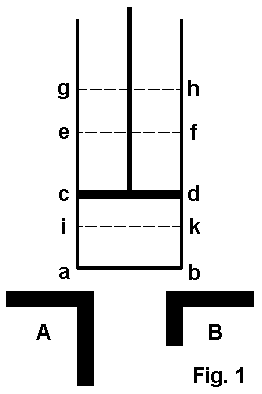
„Nachdem diese vorläufigen Punkte festgestellt worden sind, denken wir uns eine elastische Flüssigkeit, z. B. atmosphärische Luft in einem cylindrischen Gefäss a b c d , Fig. 1, mit einer beweglichen Scheidewand oder einem Kolben c d enthalten; wir denken uns ferner zwei Körper A und B , von denen jeder bei einer constanten Temperatur erhalten wird, wobei die von A höher sei, als die von B; wir stellen uns nun die nachstehend beschriebene Reihe von Operationen vor.
1. Berührung des Körpers A mit der im Raume a b c d enthaltenen Luft, oder mit der Wandung dieses Raumes, von welcher wir annehmen, dass sie die Wärme leicht durchlässt. Die Luft befindet sich vermöge dieser Berührung bei der Temperatur des Körpers A; c d sei die augenblickliche Stellung des Kolbens.
2. Der Kolben erhebt sich stetig und nimmt die Stellung e f ein. Zwischen dem Körper A und der Luft bleibt fortwährend Berührung bestehen, wodurch die Luft während der Ausdehnung bei constanter Temperatur erhalten wird. Der Körper A liefert den nötigen Wärmestoff, um die Temperatur constant zu halten.
3. Der Körper A wird entfernt und die Luft befindet sich nicht mehr in Berührung mit einem Körper, welcher ihr Wärmestoff liefern kann; der Kolben setzt indessen seine Bewegung fort und geht aus der Stellung e f in die Stellung g h . Die Luft wird verdünnt, ohne Wärmestoff aufzunehmen, und ihre Temperatur sinkt. Wir nehmen an, dass sie bis zu der des Körpers B sinkt; in diesem Augenblick bleibt der Kolben stehen und befindet sich in g h .
4. Die Luft wird nun in Berührung mit dem Körper B gesetzt; sie wird durch Senkung des Kolbens weiter comprimirt, indem man ihn aus der Stellung g h in die Stellung c d bringt. Dabei bleibt die Luft aber bei constanter Temperatur, weil sie den Körper B berührt, dem sie ihren Wärmestoff abgiebt.
5. Nachdem der Körper B entfernt ist, setzt man die Compression der Luft fort, welche in ihrem isolirten Zustande eine Temperaturerhöhung erfährt; Die Compression wird fortgesetzt, bis die Luft die Temperatur des Körpers A angenommen hat. Der Kolben bewegt sich während dieser Zeit aus der Stellung c d in die Stellung i k .
6. Die Luft wird mit dem Körper A in Berührung gebracht; der Kolben kehrt aus der Lage i k in die Lage e f zurück; die Temperatur bleibt unverändert.
7. Die unter 3. beschriebene Periode wiederholt sich, sodann die Perioden 4, 5, 6, 3, 4, 5, 6, 3, 4, 5 u. s. w.
Bei diesen verschiedenen Operationen erfährt der Kolben einen grösseren oder geringeren Druck von Seiten der im Cylinder eingeschlossenen Luft; die elastische Kraft dieser Luft ändert sich theils infolge der Volumänderungen, theils infolge der Temperaturänderungen; man muss aber darauf achten, dass bei gleichem Volum, d. h. bei gleicher Lage des Kolbens die Temperatur während der Ausdehnungsbewegung höher ist, als bei der Compressionsbewegung. Daher ist während der ersteren die elastische Kraft der Luft grösser, und somit die durch die Ausdehnungsbewegung hervorgebrachte bewegende Kraft beträchtlicher als die, welche zur Erzeugung der Compressionsbewegung verbraucht worden ist. Man erhält also einen Überschuss an bewegender Kraft, welchen man zu beliebigen Zwecken verwerthen kann. Die Luft hat uns als Wärmemaschine gedient; wir haben sie sogar auf die möglichst vortheilhafte Weise benutzt, weil keine unbenutzte Wiederherstellung des Gleichgewichts des Wärmestoffes stattgefunden hat.
Alle oben beschriebenen Vorgänge können in einem Sinne ebenso wie in umgekehrter Ordnung hervorgebracht werden. Denken wir uns nach der sechsten Periode, d. h. nachdem der Kolben in die Stellung e f gelangt ist, man ihn in die Stellung i k zurückgehen lässt, während man gleichzeitig die Luft in Berührung mit dem Körper A erhält; der während der sechsten Periode von diesem gelieferte Wärmestoff kehrt zu seiner Quelle, d. h. zum Körper A zurück und die Sachen befinden sich in dem Zustande, wie am Ende der fünften Periode. Entfernt man nun den Körper A und bewegt man den Kolben von e f nach c d , so wird die Temperatur der Luft um eben so viele Grade sinken, wie sie in der fünften Periode gestiegen war, und wird gleich der des Körpers B werden. Man kann offenbar eine Reihe von Operationen erfolgen lassen, welche alle die Umkehrung der oben beschriebenen sind; es genügt, sich unter dieselben Umstände zu versetzen, und für jede Periode eine Ausdehnungsbewegung statt einer Compressionsbewegung auszuführen, und umgekehrt.
Das Ergebnis der erstgenannten Operationen war die Erzeugung einer gewissen Menge bewegender Kraft und die Uebertragung von Wärmestoff aus dem Körper A in den Körper B ; das Ergebnis der umgekehrten Operationen ist der Verbrauch der erzeugten bewegenden Kraft und die Rückführung des Wärmestoffs von B nach A , so dass die beiden Arten von Operationen einander aufheben, einander sozusagen neutralisiren.“ (Ende des Zitats)
In diesem Zusammenhang ist auch der von CARNOT auf Seite 23 aufgestellte Satz von besonderer Bedeutung (Zitat aus CARNOT 1824/1909):
„Die bewegende Kraft der Wärme ist unabhängig von dem Agens, welches zu ihrer Gewinnung benutzt wird, und ihre Menge wird einzig durch die Temperaturen der Körper bestimmt, zwischen denen in letzter Linie die Ueberführung des Wärmestoffes stattfindet. Es ist hierbei vorausgesetzt, dass jede der Methoden, die bewegende Kraft zu gewinnen, die Vollkommenheit erreicht, deren sie fähig ist. Diese Bedingung ist erfüllt, wenn, wie oben erwähnt, keine anderen Temperaturänderungen in den Körpern stattfinden als solche, die durch Volumänderungen hervorgerufen werden, oder, was dasselbe in anderer Ausdrucksform ist, wenn niemals eine Berührung zwischen Körpern von merklich verschiedener Temperatur stattfindet.“ (Ende des Zitats)
CARNOT macht hier deutlich, daß er einen idealisierten Kreis-Prozeß beschreibt, bei dem alle Temperatur-Gefälle vernachlässigt werden. Unausgesprochen setzt er auch voraus, daß Wärmeverluste durch Abstrahlung und Ableitung nicht auftreten sollen. Er erkennt klar, daß unter diesen Voraussetzungen die Kältemaschine (heute vielfach als Wärmepumpe bezeichnet) die direkte Umkehrung der Wärme-Kraftmaschine ist und daß beide Maschinen vollkommen gleichwertig sind. In beiden Fällen wird eine 100 %ige Umsetzung von „Wärmestoff“ in „bewegende Kraft“ und umgekehrt gefolgert. CARNOT beschreibt hier auf seine Weise – unter Hinweis auf die Unmöglichkeit eines perpetuum mobile (S. 13/14 seiner Arbeit) – was später als Energie-Erhaltungs-Prinzip in die Naturwissenschaften eingegangen ist. Der Kreis-Prozeß nach CARNOT wird heute vorwiegend im sog. pV-Diagramm dargestellt, bei dem das Volumen als Abszisse und der Druck als Ordinate aufgetragen ist (BILD 1).
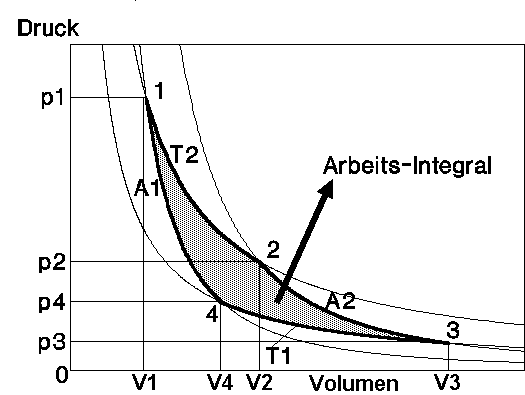
BILD 1: CARNOTscher Kreisprozeß, schematische Darstellung.
V = Volumen (Abszisse)
p = Druck (Ordinate)
A1 = untere Adiabate
A2 = obere Adiabate
T1 = Isotherme mit Temperatur T1 = const.
T2 = Isotherme mit Temperatur T2 = const. ( T2 > T1)
D. Der sogenannte „CARNOTsche Wirkungsgrad“
Wie bereits gesagt, hat CARNOT selbst eine Formel für den Wirkungsgrad nicht angegeben. Diese wurde erst von CLAUSIUS entwickelt.
Die auf CLAUSIUS (1887) zurückgehende Ableitung des sogenannten „CARNOTschen Wirkungsgrades“ erfolgt bei verschiedenen Autoren auf unterschiedliche Weise. Es wird beispielsweise auf CERBE / HOFFMANN (1982): „Einführung in die Wärmelehre“, Seiten 89 – 91, verwiesen.
Dort wird als Ergebnis angegeben (unter Anpassung der Indizes an unsere Definitionen gemäß vorstehendem BILD 1):
[1] h = 1 – T1 / T2 = (T2 – T1) / T2
Vorstehende Beziehung [1] ist das allgemein anerkannte Ergebnis für den „CARNOTschen Wirkungsgrad“ (CARNOT-Faktor), der als der größtmögliche Wirkungsgrad für geschlossene thermische Kreisprozesse bezeichnet wird. Hieraus sind die umstrittenen Begriffe Entropie und Exergie abgeleitet worden.
Die Gleichung [1] besagt, daß ein Wirkungsgrad von 100 % nur erreichbar ist, wenn die Temperatur T1 des kälteren Körpers B (vgl. die Figur 1 von CARNOT) T1 = 0 ist, also auf dem absoluten Temperatur-Nullpunkt liegt. Bei praktisch realen Temperaturen ergeben sich vergleichsweise sehr geringe Wirkungsgrade. So erhält man z. B. bei T2 = 40° C und T1 = 20° C entsprechend T2 = 313° K und T1 = 293° K nur einen Wirkungsgrad von 6,4 %, obwohl alle technisch realen Verluste (vgl. Abschnitt F) voraussetzungsgemäß vernachlässigt worden sind.
Obgleich die Ableitung zu [1] im Rahmen der gegebenen Voraussetzungen mathematisch fehlerfrei ist, sind dennoch drei grundlegende physikalische Irrtümer enthalten. Hierauf soll im folgenden Abschnitt eingegangen werden.
E. Drei grundlegende physikalische Irrtümer
Es erhebt sich nun die FRAGE:
Wo liegen die grundlegenden Irrtümer in der genannten Ableitung?
Die ANTWORTEN lauten:
Irrtum 1.
Der CARNOT-sche Prozeß wird als geschlossener thermischer Kreisprozeß bezeichnet. Jedoch ist er lediglich geschlossen bezüglich des eingeschlossenen Arbeitsmittels (Gasmasse), nicht jedoch bezüglich der Wärmeenergie. Denn der „heiße“ Speicher (Körper A) muß dauernd nachgeheizt und der „kalte“ Speicher (Körper B) dauernd gekühlt werden, um die vorausgesetzte konstante Temperatur zu erhalten. Die mathematisch so elegante Annahme einer Temperatur-Konstanz der beiden Speicher ist also physikalisch vollkommen unvernünftig, da damit vorgetäuscht wird, die beiden Speicher befänden sich in einem statischen Zustand. In Wirklichkeit ist dauernd ein Energiefluß (Wärmestrom) gegeben, der einerseits von außen in den jeweiligen Speicher einströmt, andererseits an das Arbeitsmittel (Gasmasse) abgegeben wird. Die Speicher sind allerdings notwendig, um zeitliche Schwankungen des Energieflusses auszugleichen.
Irrtum 2.
Es wurde übersehen, daß Wärmeenergie bei dem hier betrachteten thermo-dynamischen Prozeß sowohl als statische Größe (Wärmeenergie = Temperatur mal Wärmekapazität) als auch als dynamische Größe (Wärmeenergie = Temperaturdifferenz mal Energiefluß) auftritt. Bei dem theoretischen Ansatz nach CLAUSIUS ist nur die statische Größe berücksichtigt entsprechend der Zustandgleichung für das ideale Gas:
p · V = m · R · T
p = Druck
V = Volumen
m = Masse der Gasfüllung
R = universelle Gaskonstante
T = absolute Temperatur
Hierbei kann die Konstante R als Wärmekapazität interpretiert werden.
Aus folgender Betrachtung geht nun hervor, daß die Wärmeenergie als dynamische Größe unberücksichtigt geblieben ist. Hierfür ist nämlich die folgende Voraussetzung von CARNOT wesentlich (siehe das oben gebrachte Zitat aus CARNOT 1824/1909, Seite 23):
„Es ist hierbei vorausgesetzt, dass jede der Methoden, die bewegende Kraft zu gewinnen, die Vollkommenheit erreicht, deren sie fähig ist. Diese Bedingung ist erfüllt, wenn, wie oben erwähnt, keine anderen Temperaturänderungen in den Körpern stattfinden als solche, die durch Volumänderungen hervorgerufen werden, oder, was dasselbe in anderer Ausdrucksform ist, wenn niemals eine Berührung zwischen Körpern von merklich verschiedener Temperatur stattfindet.“ (Ende des Zitats)
CARNOT ist sich hier offensichtlich bewußt, daß ein Energiefluß zwischen zwei Körpern nur bei einer endlichen Temperaturdifferenz möglich ist, daß aber die Vollkommenheit nur dann erreicht wird, wenn diese Temperatur-differenz sehr klein ist.
Im theoretischen Ansatz nach CLAUSIUS ist aber an keiner Stelle eine solche kleine Temperaturdifferenz eingeführt worden. Die Temperatur-differenz zwischen den Körpern ist vielmehr stillschweigend gleich NULL gesetzt worden, so daß ein thermischer Energiefluß gar nicht möglich ist.
Es hätte hier im Ansatz eine differentiell kleine Temperaturdifferenz eingeführt werden müssen, die dann in einem Grenzwertübergang zur angestrebten Vollkommenheit geführt hätte. Die NULL-Setzung im vorliegenden Fall nimmt jedoch der theoretischen Untersuchung jeden physikalisch realen Wert. Ein thermischer Energiefluß findet überhaupt nicht statt. Damit ist jede Aussage über Energiegrößen und Wirkungsgrade unmöglich.
Irrtum 3.
Bei der Integration über p·dV wurde die Umgebungs-Temperatur nicht berücksichtigt. Denn die Umgebung wirkt als sehr großer thermischer Energie-Speicher, der als Temperatur-Bezugs-Niveau die Grenze zwischen positiven und negativen Temperatur-Differenzen und Energieflüssen bildet und in die Rechnung mit einzubeziehen ist. Dieser Energie-Speicher dient nämlich zur thermischen „Abstützung“ der beiden von CARNOT vorausgesetzten wärmespeichernden Körper A und B (siehe Fig. 1 nach CARNOT).
Diesen grundlegenden Irrtum hat wohl BARTH als erster klar herausgestellt. In dem Buch von BARTH (1962): „Rationale Physik“ im Kapitel: „Wärme als eine Form der Energie“ wird auf Seite 256, zweiter Abs., ausgeführt (Zitat):
„Die Umsetzung mechanischer Energie in Wärmeenergie besteht notwendig in der Erhöhung der thermischen potentiellen Energie, in einer Erhöhung des thermischen Potentials. Jedoch nicht absolut genommen, sondern in der relativen Erhöhung des Potentials, in der Bildung einer Temperaturdifferenz. Die Energiebilanz wird allein durch diese Temperaturdifferenz bestimmt, nicht durch absolute Temperaturen. Eine Temperaturabnahme, also eine negative Temperatur gegen die Umgebung bedeutet ebenso eine Zunahme der thermischen potentiellen Energie wie eine Temperaturerhöhung. Beim Thomson-Jouleeffekt wird demnach in jedem Fall mechanische Energie in thermische Energie umgewandelt, gleichgültig ob nun das Gas sich erwärmt oder abkühlt. Die erzeugte Wärmeenergie ist allein bestimmt durch die entstandene Temperaturdifferenz (gegen die wirkliche Umgebung), aber nicht durch eine theoretische absolute Temperatur.“ (Ende des Zitats)
Zur Veranschaulichung dieses von BARTH zutreffend herausgestellten Sachverhaltes wird auf BILD 2 und BILD 3 verwiesen. Dabei ist die als konstant angenommene absolute Umgebungs-Temperatur mit Tu bezeichnet. Zu berücksichtigen ist allerdings, daß Tu in der Realität nie konstant ist (Winter, Sommer; Nacht, Tag usw.). Es ist hier ähnlich zu verfahren, wie bei mechanischen Niveau-Betrachtungen bezüglich der Meereshöhe über NN (Normal-Null). Denn auch die Meereshöhe ist in Wirklichkeit nicht konstant (z. B. Schwankungen durch Ebbe und Flut).
Ferner genügt es nicht, die Lufttemperatur in unmittelbarer Umgebung des betrachteten thermodynamischen Prozesses als Tu zu betrachten, denn die Lufttemperatur wird sehr schnell durch die Wärmeabgabe des Prozesses verändert werden. Es ist vielmehr dafür zu sorgen, daß ein dauernder, großräumiger Temperaturausgleich stattfindet. Es bieten sich daher für die Festlegung einer Normal-Umgebungs-Temperatur Tu die Weltmeere bei hinreichender Meerestiefe an.
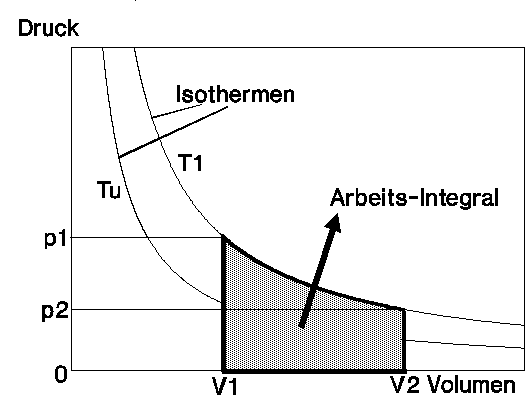
BILD 2: FALSCH ——- Arbeits-Integral unter der Isotherme.
V = Volumen (Abszisse) p = Druck (Ordinate) T1 = Isotherme mit Temperatur T1 = const. Tu = Isotherme mit der Umgebungs-Temperatur Tu
Tu = const. ( T1 > Tu )
Bei der genannten Ableitung wurde entsprechend BILD 2 das Arbeits-Integral unter der Isotherme irrtümlich gegenüber der absoluten Temperatur = NULL (Abszissen-Gerade) gebildet. Die Umgebungs-Temperatur Tu wurde fälschlich außer acht gelassen.
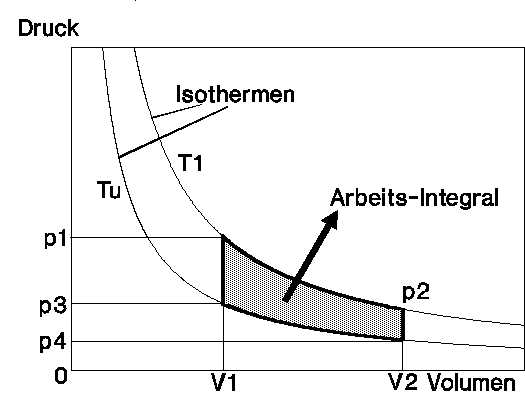
BILD 3: RICHTIG ——- Arbeits-Integral unter der Isotherme.
V = Volumen (Abszisse)
p = Druck (Ordinate)
T1 = Isotherme mit Temperatur T1 = const.
Tu = Isotherme mit der Umgebungs-Temperatur Tu
Tu = const. ( T1 > Tu )
BILD 3 verdeutlicht die richtige Bestimmung des Arbeits-Integrals. Diese richtige Integration ergibt ein wesentlich kleineres Arbeits-Integral. Das Entsprechende gilt auch für die Isotherme T2. Anschließend ist die Summe bzw. Differenz der Arbeits-Integrale unter T1 und T2 zu bilden.
Damit erhält man für den „CARNOTschen Wirkungsgrad“ h :
[2] h = 1 – (T1 – Tu) / (T2 – Tu)
Hierbei ist die Voraussetzung von CARNOT wesentlich (siehe das oben schon gebrachte Zitat aus CARNOT 1824/1909, Seite 23):
„Es ist hierbei vorausgesetzt, dass jede der Methoden, die bewegende Kraft zu gewinnen, die Vollkommenheit erreicht, deren sie fähig ist. Diese Bedingung ist erfüllt, wenn, wie oben erwähnt, keine anderen Temperaturänderungen in den Körpern stattfinden als solche, die durch Volumänderungen hervorgerufen werden, oder, was dasselbe in anderer Ausdrucksform ist, wenn niemals eine Berührung zwischen Körpern von merklich verschiedener Temperatur stattfindet.“ (Ende des Zitats)
Über die Berücksichtigung von Verlusten, die außerhalb dieser Voraussetzung liegen, siehe den Abschnitt F.
In Glg. [2] sind nun folgende Sonderfälle enthalten:
1. T2 > T1, T1 > Tu
Bei diesem Fall sind – wegen T1 > Tu und T2 > T1 > Tu – beide Klammer-ausdrücke in [2] positiv und der Wirkungsgrad wird kleiner als 100 %. Der Kreisprozeß ist also verlustbehaftet. Dies folgt daraus, daß der kältere Speicher (Körper B gemäß Fig. 1 nach CARNOT) dauernd Wärme, die ihm bei jedem Zyklus zugeführt wird, an die Umgebung abgeben muß, um seine Temperatur zu halten.
2. T2 > T1, T1 = Tu
Hierbei ist die Temperatur des kälteren Speichers gleich der Umgebungs-Temperatur gewählt. Nun erhält man als Wirkungsgrad:
[3] h = 1 – (T1 – T1) / (T2 – T1) = 1 = 100 %
Es treten also bei den gegebenen Voraussetzungen keinerlei Verluste auf. Glg. [3] stellt daher den optimalen Wirkungsgrad einer thermodynamischen Maschine dar. Dieses Ergebnis weicht entscheidend von Lehrbuchaussagen ab.
3. T2 > Tu, T1 < Tu
Hierbei ist die Temperatur des „kalten“ Speichers bewußt unterhalb die Umgebungstemperatur gelegt. Das gelingt natürlich nur, wenn dieser Speicher dauernd – unter Energieaufwand – gekühlt wird. Es ergibt sich:
[4] h = 1 – (Tu – T1) / (T2 – Tu)
Dieser Kreisprozeß ist – wegen der erforderlichen Kühlung des „kalten“ Speichers – ebenfalls verlustbehaftet.
Das Ergebnis nach den Glgn. [2], [3] und [4] ist – ebenso wie bei der klassischen Formel für den „CARNOTschen Wirkungsgrad“ – unabhängig vom Umgebungs-Druck, so daß dieser auch durch eine konstante positive oder negative Vorlast in weiten Grenzen frei gewählt werden kann. Diese Unabhängigkeit von einer Vorlast erklärt sich dadurch, daß die Vorlast zwar bei dem einen Kolbenhub positive Arbeit, bei dem entgegengesetzten Kolbenhub aber eine gleich große negative Arbeit verrichtet. Dies trifft sogar bei einer Vorlast durch eine lineare oder nichtlineare mechanische Feder zu, da auch diese bei einem geschlossenen Zyklus im Ergebnis keine Arbeit verrichtet.
Es könnte jetzt der Einwand erhoben werden, daß die Glg. [3] unmöglich richtig sein könne, da doch zweifellos längs der Isotherme mit der Temperatur T1 Energie in den Speicher mit der Temperatur T1 abfließe. Diese Energie gehe dadurch „verloren“ und sei deshalb den Verlusten zuzurechnen. Hier liegt ein grundlegender Irrtum vor. Denn bei dieser Isotherme ist nicht nur der Energiefluß sondern auch die – voraussetzungsgemäß sehr kleine – Differenz-Temperatur zwischen Arbeitsmittel und äußerem Speicher negativ. Es ergibt sich also, da das Produkt zweier negativer Größen wieder positiv ist, für einen vollen Zyklus des CARNOTschen Kreisprozesses bei jeder der beiden Isothermen ein positiver thermischer Energie-Aufwand, der jeweils zu 100 % in mechanische Arbeit umgewandelt wird. Denn Energie ist stets das Produkt zweier Parameter, wie schon BARTH (1986, 1987) zutreffend ausgeführt hat. Bei Vernachlässigung aller Verluste ist daher der optimale Wirkungsgrad einer thermodynamischen Maschine gleich 100 % – in Übereinstimmung mit der Auffassung von CARNOT und im Gegensatz zu zahlreichen Lehrbuch-Darstellungen.
F. Berücksichtigung der Verluste
Aufgrund der Wirkungsgrad-Definition, die für mechanische, elektrische und thermische Prozesse in gleicher Weise gilt, ergibt sich der Wirkungsgrad h allgemein zu:
Wirkungsgrad h = Wab / Wzu = (Wzu – Vsu) / Wzu
Dabei bedeuten:
Wab = abgeführte Nutz-Energie
Wzu = zugeführter Energie-Aufwand
Vsu = Summe der Verluste
Die Bilanzierung: Wab = Wzu – Vsu ist gemäß Energie-Erhaltungs-Prinzip zwingend, auch wenn zunächst die Summe der Verluste nicht bekannt ist.
Die Verluste bei thermischen Prozessen sind im wesentlichen gegeben durch:
a) Verluste durch Wärme-Ableitung, Wärme-Abstrahlung und Wärme-Widerstände
b) Verluste durch mechanische Reibungen einschließlich Luftwirbel-Reibungen
c) Verluste durch pneumatische Undichtigkeiten, vor allem zwischen Kolben und Zylinder
Bei Berücksichtigung der Verluste ergibt sich stets ein Wirkungsgrad kleiner als 100 % , wenn „negative“ Verluste (z. B. Wärme-Einstrahlung von außen durch die Sonne) ausgeschlossen werden können. Die einzelnen Verluste müssen je für sich bestimmt und dann addiert werden, um die Summe der Verluste Vsu zu erhalten.
Das Bestimmen der Einzelverluste ist im allgemeinen nicht ganz einfach. Hier können im wesentlichen nur empirische Formeln verwendet werden. Dazu sind die für Ingenieure und Techniker bestimmten Handbücher zu verwenden. Vor allem wird auf das – zahlreiche Tabellen enthaltende – Buch von CERBE / HOFFMANN (1982), verwiesen, insb. auf den Abschnitt: „8. Wärmeübertragung“ (Seiten 245 bis 282).
G. Ausblick
Der zitierten Auffassung von CARNOT (siehe Abschnitt C.) kann man aus heutiger Sicht nahezu voll zustimmen. Einen Wirkungsgrad gibt CARNOT nicht an, da er einen idealisierten Kreisprozeß beschreibt, der bewußt so konzipiert ist, daß eine volle Umkehrbarkeit zwischen Wärme-Kraftmaschine und Kälte-Maschine (Wärmepumpe) gegeben ist.
Diese Voraussetzung schließt eine 100 %ige Umwandlung in beiden Richtungen mit ein. Dieser idealisierte Kreisprozeß hat zwar praktisch nur geringe Bedeutung, da er verlangt, daß der Prozeß nur äußerst langsam, d. h. quasistatisch, ablaufen darf. Aber die Betrachtungen hierzu von CARNOT sind – im Gegensatz zu denen von CLAUSIUS – folgerichtig durchgeführt.
So schließt sich denn der Kreis. Was CARNOT schon 1824 intuitiv richtig erkannt hatte, ist durch einen Irrtum in der nicht klar durchdachten Mathematik von CLAUSIUS verfälscht worden. Aus diesem Irrtum ergeben sich weitere Fehler. Wenn auch nur einer dieser Fehler unberücksichtigt bleibt, kommt es zu unüberbrückbaren Widersprüchen. Dadurch ist die Thermodynamik zu einer in sich widersprüchlichen Theorie geworden, die in dem sog. „Zweiten Hauptsatz der Thermodynamik“ gipfelt und die seit mehr als 130 Jahren als wissenschaftliches Dogma die Lehrbücher belastet.
Die Folgen des behandelten Irrtums sind weit größer, als es zunächst erscheinen mag. Der ursächliche Zusammenhang der fehlerhaften Thermodynamik mit der derzeit diskutierten „Klima-Katastrophe“ wird wohl erstmals klar von KIRCHHOFF (1990) herausgestellt. Das aufmerksame Studium dieser sehr detaillierten historischen Analyse wird dringend empfohlen. Damit in engem Zusammenhang steht der unverantwortlich schlechte Wirkungsgrad der Dampfkraftwerke einschließlich der Atomkraftwerke, die den Dampfmaschinenprozeß einschließen. Hierzu wird vor allem auf STRACH (1991) verwiesen. Hierin heißt es u. a. (Zitat):
„Auch die Vorstellung, das ca. 80 °C heiße Kondensat, das als „Abfall“ aus der Dampfmaschine anfällt, für Fernwärme zu nutzen, ist so verlockend wie unrealistisch. – Die Produktionsprozesse, die rund um die Uhr laufen müssen, stellen 8600 Stunden im Jahr Fernwärme zur Verfügung. ‚Doch jeder Klempner weiß, daß in unseren Breitengraden durchschnittlich nur 1400 Stunden Wärme benötigt werden‘, berichtet Strach. Angebot und Nachfrage sind asynchron, und in kalten Wintertagen reicht dann auch die Fernwärme zur Deckung des Heizbedarfs nicht aus.“ (Ende des Zitats)
Besonders tragisch ist, daß durch das Dogma der Thermodynamik die wissenschaftliche Weiterentwicklung in sehr unerfreulicher Weise blockiert wird. Hierzu wird auf HILSCHER (1981) und BARTH (1987) hingewiesen. Bei BARTH (1987) heißt es ganz am Schluß (Zitat):
„Die mechanische Wärmetheorie mit ihren zahlreichen mathematischen und physikalischen Fehlern, mit Wärmetod und „Entropie“ versperrt jeden echten Fortschritt.“ (Ende des Zitats)
Literatur:
BARTH, G. (1962): „Rationale Physik“, Verlag „Wissen im Werden“, A-2063 Zwingendorf, Österreich, Haus Bradley
BARTH, G. (1975): „Energetische Wärmetheorie“, Verlag „Wissen im Werden“, A-2063 Zwingendorf, Österreich, Haus Bradley
BARTH, G. (1986): „Wenn Wärme nicht als „minderwertige“ Energie angesehen würde…“ aus Zeitschrift: „Sonnenenergie“ 5/86, S. 30 – 31
BARTH, G. (1987): „Die Fehler der mechanischen Wärmetheorie“, aus „raum & zeit“ 30/87, S. 78 – 82
BLÖSS, Chr. (1985): „Der Entropie-Begriff – Ein Irrtum und seine Folgen für die Thermodynamik“, DABEI-Colloquium Heft 3, Bonn
CARNOT, S. (1824): „Betrachtungen über die bewegende Kraft des Feuers“, Reihe Ostwalds Klassiker, Bd. 37, Leipzig 1909
CERBE / HOFFMANN (1982): „Einführung in die Wärmelehre“, 6. Auflg., Carl Hanser Verlag, München, Wien
CLAUSIUS, R. (1887): „Die mechanische Wärmetheorie“, Bd. 1, 3. Auflg., Verlag Friedr. Vieweg, Braunschweig
FRIEBE, E. (1987): „Wo liegen die ursächlichen Irrtümer in der theoretischen Thermodynamik?“, Zeitschr. „raum & zeit“, 28/87, S. 68 – 71
FRIEBE, E. (1988): „Die Widersprüche der Thermodynamik“, Zeitschr. „raum & zeit“, 36/88, S. 84 – 86
FRIEBE, E. (1990): „Das Energie-Erhaltungs-Prinzip – Ursache zahlreicher Mißverständnisse“, DPG-Didaktik-Tagungsband 1990, S. 654 – 659. Hrsg.: Prof. Dr. Wilfried KUHN, Gießen
HILSCHER, G. (1981): „Energie im Überfluß – Ergebnisse unkonventionellen Denkens“, Adolf Sponholtz Verlag, Hameln
HILSCHER, G. (1986): „Kohlendioxid als Arbeitsmittel nutzen – Ziel einer Neuentwicklung: Strom aus Solar- und Abwärme“, Zeitschr. „Sonnenenergie“ 3/86, S. 6 – 7
KIRCHHOFF, J. (1986): „Von der durchschaubaren Dampfmaschine zum nebulösen thermodynamischen Lehrinhalt“, Verlag Kirchhoff, Herten-Westerholt
KIRCHHOFF, J. (1987): „Zur Theorie und Praxis von Wärmekraftmaschinen“, Zeitschr. „Sonnenenergie“ 1/87, S. 12 – 15
KIRCHHOFF, J. (1990): „PERPETUUM MOBILE und Klima-Katastrophe“, aus „raum & zeit“ 45/90, S. 82 – 86, und 46/90, S. 72 – 82
STRACH, L. (1991): „Abwärme bringt Heißluft-Turbine auf Touren“, Zeitungsbericht von B. B. aus „VDI Nachrich