Nature of Light
Copyright © 2008 by Sunil Thakur
Zitat:
Abstract:
Wave particle duality ensures that nature of light remains an enigma. In fact, physics does not even attempt to explain what light is, we only know how light behaves in specific conditions. This paper presents the most comprehensive analysis of the nature of light including an exploration into structural part of the electromagnetic waves. The results are startling and yet utterly simple to interpret.
Considering the importance of the subject, I have kept the discussion reasonably non-technical so that the subject remains within the reach of even a non-physicist. Even the experiments selected specifically for this article can be performed and interpreted by a high-school student.
Experimentelle Widerlegung der relativistischen Zeitdilatation
von Univ.-Prof. Dipl.-Ing. Dr. Hartwig Thim
Zitat:
Nach der speziellen Relativitätstheorie gehen relativ zu einander bewegte Uhren langsamer, von relativ zu einander bewegten Zwillingen altert also jeweils der andere langsamer. Der dafür verantwortliche Mechanismus ist die aus den Lorentz-Transformationen abgeleitete „Zeitdilatation“ oder „Zeitdehnung“. Schon im Jahre 1911, also bereits 6 Jahre nach dem Erscheinen der Arbeit von Einstein, wies Langevin auf einen Widerspruch in dieser Folgerung hin, daß nämlich jeder den jeweils anderen Zwilling langsamer altern sieht, da es laut Relativitätstheorie ja nur auf die Relativbewegung zwischen den Zwillingen ankommt und nicht darauf, wer vorher beschleunigt wurde. Welcher Zwilling ist also tatsächlich jünger?
Dieser als „Zwillings-Paradoxon“ bekannte Widerspruch wurde nun durch ein an der Universität Linz von Professor Thim durchgeführtes Experiment aufgelöst. Mit Hilfe eines Mikrowellen-Interferometers konnte nämlich nachgewiesen werden, dass es die ebenfalls auf der Zeitdilatation basierende „transversale Dopplerverschiebung“ gar nicht gibt, obwohl dieses als „relativistischer Dopplereffekt“ bekannte Phänomen bisher als gesichert ange-nommen wurde. Die Meßergebnisse wurden bereits veröffentlicht* und in Europa und USA auf Kongressen vorgetragen. Damit wurde die spezielle Relativitätstheorie das erste Mal experimentell eindeutig widerlegt, was für die moderne Physik weitreichende Konsequenzen nach sich ziehen wird. Die Relativitätstheorie wird allerdings schon längere Zeit aufgrund ihrer Inkompatibilität mit der Quantenmechanik in Frage gestellt. Erst kürzlich forderte der frühere Herausgeber von „Nature“, Sir John Maddox, in einem Vortrag beim Wissenschaftstag 2001 der Österreichischen Forschungsgemeinschaft im Hotel Panhans am Semmering die Aufgabe der Relativitätstheorie.
Den ganzen Beitrag lesen »

Book Review [Physics Essays volume 11, number 2, 1998]
Paul Marmet:
„Einstein’s Theory of Relativity versus Classical Mechanics“
(Newton Physics Books, 2401 Ogilvie Road, Gloucester, ON, K1J 7N4 Canada, ISBN 0-921272-18-9).
Zitat:
I was told a story recently about how government funding of the U.S. hot fusion program acquired its character: it was asserted that certain officials knew perfectly well from the start that the only practical chance of success lay in directedenergy schemes, but that the sheer number of physicists adhering to the thermonuclear religion, coupled to matters of congressional representation, made it necessary to ship the bulk of the millions to Princeton in order that a few thousand might trickle down to the outsiders investigating physically likelier approaches. (But of course predictable cutbacks soon froze out the latter, while the thermonucleacs sail on in state–to nowhere. )
True or not, this story about the experimental side of Big Physics seems even more appropriate in application to the theoretical side. There, the relevant coinage is to be reckoned more in prestige, „recognition,“ or reverence than in money. All the big reverence shipments go to the East Coast Ivy League academies, wherein it is a recognized condition of employment to evidence right-thinking in response to such Inquisitorial test questions as, Was Einstein right? Any original thinking on such matters is a closet activity too rare and dangerous to be shared even among consenting adults. As our ideological disciplinarians torque up their definitions, the right-thinkers sail on to their boreal Ultima Thule, and original thought about fundamentals is progressively frozen out. Indeed, the retreat of pluralism has come to be the working definition of „progress“ along the new road to Truth–the one that proceeds through consensus of authorities. Older physicists in the days of tangible progress would have laughed at this new road, as leading straight to antiscience. Their names we honor, but not their precepts.
Den ganzen Beitrag lesen »
Ich nehme Bezug auf meinen Blog-Eintrag:
„Stützt sich die SRT auf die Kinematik des starren Körpers?“
Dort wird unter „Literatur“ auf folgendes Buch hingewiesen:
Rudakov, N.: „Fiction stranger than truth : in the metaphysical labyrinth of relativity“.
Geelong, Vic., Australia: The Author [Selbstverlag], 1981. 175 S.
Nachstehend bringe ich eine Leseprobe hieraus:
Zitat:
1 Establishment
In the last sixty years physics has been enslaved by theoreticians who have succeeded in abolishing physical reality and replacing it with an empty and barren mathematical formalism. The new physicist no longer studies nature and describes what he has observed in physically meaningful terms. He sits at the desk, manipulates abstract symbols and figures, and communicates what the universe is like and how it ought to behave in the form of equations which are comprehensible only to a small and exclusive group of theoreticians like himself.
The principal device which brought about the mathematical captivity of physics is Einstein’s first theory of relativity. It is usually referred to as the restricted or special theory, or as special relativity. This theory will be critically examined in the following pages, particularly in regard to its meta-physical implications. The term relativity, or relativity theory, in this work will mean primarily special relativity, although in some cases, where the distinction is not essential, it may also cover Einstein’s second relativity theory, known as general relativity.
Den ganzen Beitrag lesen »
An Analysis of the Theoretical Foundations of Special Relativity
Copyright © Walter Babin
Zitat:
The concept of the relativity of time, space and simultaneity as specifically proposed in the Special Theory is proven to be logically untenable. It is shown that assumptions regarding absolutism or relativism cannot be substantiated within the context of the two postulates and that a re-interpretation of the constancy of the speed of light effectively accounts for the null result of the Michelson-Morley experiment.
1. INTRODUCTION
The Special Theory has withstood the scrutiny of countless investigators over the past ninety years and has become one of the intellectual cornerstones of modern physics. Despite this, it is contended that the kinematic aspects of the theory contain a number of serious philosophical and logical inconsistencies which effectively nullify it as a basis for dynamic considerations. Among these are the unsatisfactory interpretation of the first postulate, the arbitrary limitations imposed on the means to determine synchronism and simultaneity, and the total exclusion of one-dimensional aspects in the justification for, and calculation of space-time modifications.
2. THE SPEED OF LIGHT
In his original paper on the Special Theory (1.), Dr. Einstein confirms the Galilean equivalence of inertial frames of reference and adds a second postulate which states –
„…light is always propagated in empty space with a definite velocity [ c ] which is independent of the state of motion of the emitting body.“
Den ganzen Beitrag lesen »
A sign error in the Minkowski space-time plot and its consequences
by J.H.Field, Département de Physique Nucléaire et Corpusculaire Université de Genève.
24, quai Ernest-Ansermet CH-1211 Genève 4. (23. May 2008)
Zitat:
Abstract
A sign error in an angle while drawing the original Minkowski plot has persisted for a century in text books and the pedagogical literature. When it is corrected, the ‚length contraction‘ effect derived from the geometry of the plot disappears. It is also shown how the ‚relativity of simultaneity‘ effect that has been derived from the plot results from a lack of correspondence between certain geometrical projections on the plot and the properties of the physical system -two spatially separated and synchronised clocks in a common inertial frame – that they are purported to describe.
1 Introduction
Errors, originating in Einstein’s 1905 special relativity paper [1], in the standard text book interpretation of the physics of the space-time Lorentz transformation (LT), have been pointed out in a series of recent papers by the present author [2, 3, 4]. In these papers it is shown that the ‚length contraction‘ and ‚relativity of simultaneity‘ effects, derived directly from the LT, are spurious, resulting from a failure to include important additive constants in the equations. Einstein pointed out the necessity to include such constants, to correctly describe synchronised clocks, in Ref. [1], but never actually did so himself. Since the demonstration of the spurious nature of the effects is simple, straightforward and brief, it is recalled, for the reader’s convenience, in the following section of the present paper.
Den ganzen Beitrag lesen »
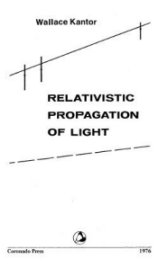
Hiermit empfehlen wir ein ganz wichtiges Buch zur Relativitätstheorie, das klar aufzeigt, daß das „Postulat der Konstanz der Lichtgeschwindigkeit“ auf grundlegenden Irrtümern beruht:
KANTOR, Wallace (1976): „Relativistic Propagation of Light“,
Coronado Press, Lawrence, Kansas.
(Dieses Buch ist in vielen wissenschaftlichen Bibliotheken in Deutschland verfügbar)
Beachten Sie bitte auch die Hinweise auf Wallace KANTOR
in Kapitel 4 der Dokumentation von G. O. Mueller, Suchwort: Kantor.
Im Vorwort dieses Buches wird ausgeführt (Zitat von Seite ‚v‘, Übersetzung aus dem Amerikanischen):
Zitat:
„Diese Monographie zeigt – an entsprechender Stelle – eine kritische Untersuchung des zugehörigen experimentellen Beweismaterials in der Kinematik der speziellen Relativitätstheorie und der alten Lichtäther-Theorie. Das Ergebnis ist überraschend; es gibt für keine dieser beiden Theorien eine kinematisch-experimentelle Stütze. Anstatt dessen gibt es viel unberücksichtigtes experimentelles Beweismaterial, sowohl qualitativ als auch quantitativ, das diesen Theorien widerspricht.
Es gibt andererseits experimentelle Beweise bis zu einer Genauigkeit von ein oder zwei Prozent, die zeigen, daß die Lichtgeschwindigkeit in Wirklichkeit abhängt von der Bewegung ihrer Quelle zum Zeitpunkt der Emission von der bewegten Quelle.
Den ganzen Beitrag lesen »
Zifeng Li
Yanshan University, Qinhuangdao, Hebei 066004, China
(Received 4 January 2006; accepted 2 April 2008)
Zitat:
Abstract: All experiments show that the speed of light relative to its source measured in vacuum is constant. Einstein interpreted this fact such that any ray of light moves in the „stationary“ system with a fixed velocity c, whether the ray is emitted by a stationary or by a moving body, and established special relativity accordingly. This paper reviews basic hypotheses and viewpoints of space-time relationship in special relativity; analyzes derivation processes and the mistakes in the Lorentz transformation and Einstein’s original paper. The transformation between two coordinate systems moving uniformly relative to one another is established. It is shown that special relativity based upon the Lorentz transformation is not correct, and that the relative speed between two objects can be faster than the speed of light. © 2008 Physics Essays Publication. [DOI: 10.4006/1.3006345]
Den ganzen Beitrag lesen »
RELATIVITY – joke or swindle?
von Dr. Louis Essen, D.Sc., F.R.S.
Louis Essen re-states his view that Einstein’s theory of relativity contains basic and fatal flaws.
Quelle:
ESSEN, L (1988): Electronics & Wireless World, p. 126-127, February 1988
Zitat:
Some of your contributors find it difficult to accept my contention (WW October, 1978) that Einstein’s theory of relativity is invalidated by its internal errors. Butterfield for example (WW February, 1987) denies that there is any duplication of units or any harm in obtaining results from thought-experiments. Moreover, if my contention is correct, the new experimental work described by Aspden (EWW, August, 1987 ) is not required to disprove the theory, although it might confirm that his assumptions were wrong. This is not to suggest that experimental results are not important but they should be considered as steps in the development of new theories.
Discussions about the theory tend to be very involved and your readers may be interested in a brief history of the subject which I wrote some time ago for a friend who wanted to know what the controversy was about and in particular what was the significance of the clock paradox.
Den ganzen Beitrag lesen »
