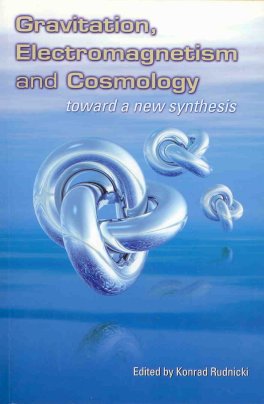
by Prof. Konrad Rudnicki (Editor)
Description
Based on papers originally presented at an international conference on Redshifts and gravitation in a relativistic universe, held Sept. 17-20, 1999, Cesena, Italy, this book features essays by Prof. Andre K. T. Assis, Henrik Broberg, Dr. Franco Selleri, Dr. Tom Van Flandern, Dr. Halton C. Arp, Bernard R. Bligh and others.
Den ganzen Beitrag lesen »
von Jocelyne Lopez

Zitat vom 10. März 2012:
Ich verweise auf meine Anfrage vom 20.02.12 an die Bundesministerin für Bildung und Forschung Annette Schavan über die Vermittlung der Kritik der Speziellen Relativitätstheorie im öffentlichen Bildungssystem und gebe einen E-Mail-Austausch wieder:
07.03.2012 – E-Mail-Antwort von Annette Schavan:
Betreff: Vermittlung der Kritik der Speziellen Relativitätstheorie im öffentlichen Bildungssystem – Bezug: Ihre E-Mail vom 20.02.2012
Den ganzen Beitrag lesen »

By Steven Bryant
Website: www.RelativityChallenge.com
The Twin Paradox is one of the most well known and debated paradoxes associated with Relativity theory. Opponents challenge Relativity theory on the grounds that the Twin Paradox reveals an underlying flaw in the theory. Such opponents feel that the existence of a paradox, in and of itself, is sufficient to disqualify the theory.
Den ganzen Beitrag lesen »

By Janusz D. Laski, Kraków, POLAND
In vector calculus the addition of two vectors means no more than the addition of their components. According to Special Relativity Theory (SRT) the addition of two velocities signifies more than that. Apart from adding the components we have to divide their sum by a coefficient 1 + (v/c)(u/c), which presence indicates that the velocity is not a vector in SRT. If the velocities in SRT were vectors they should be added up as vectors. The ratio of velocities v/c should not be considered as the hyperbolic tangent of an angel. The coefficient mentioned above appeared as the result of the baseless introduction of hyperbolic functions to the SRT formulae.
Den ganzen Beitrag lesen »

By Robert F. Beck, February 2012
This paper examines the extent to which an interpretation of Einstein’s relativity suggested in The Special Theory of Reality might provide clearer answers in areas such as gravity, quantum mechanics, string theory and particle physics generally. The extent to which the simple concepts of rings of tiny particles and rings of such particles becoming spirals suggest explanations and solutions in the area of particle physics specifically is explored and explanations suggested for all four fundamental forces. Most significantly, a description and unrealized properties of the Higgs boson are presented, and explanations are suggested for the very nature of quantum mechanics and string theory in the context of what is suggested as the true meaning of relativity. An explanation for the significance of specific frequencies in new energy and health technologies is also suggested.
Key words: relativity, mass, particle physics, quantum mechanics, string theory, Higgs boson
Lesen Sie bitte hier weiter!
In 2005 the International Centre for Theoretical Physics (ICTP) in Trieste, Italy, established its Abdus Salam electronic open archive, ostensibly for the free dissemination of scientific papers, the URL of which is http://www.ictp.it/
It turns out that this is a lie. The ICTP actually censors papers submitted to it for posting on its archive. It does not matter if the papers have been published in peer-reviewed international scientific journals or not.
Den ganzen Beitrag lesen »

By Dr. H. H. Lindner
Key words: atomism, ether, gravity, inertia, Mach’s principle, principle of equivalence, Relativity, space, strong force, transverse Doppler shift
Abstract
Relativity and Quantum Theory were designed to limit physics to describing the observer’s observations and measurements. They assumed that space is nothing, a void with no physical qualities. However, the evidence indicates that “empty” space is a substance, and as such may be the causal nexus of all fundamental physical phenomena. Physics can be reconstructed upon a theory of the nature of Cosmic space and its role in all phenomena.
Den ganzen Beitrag lesen »

In der bereits genannten Internetseite http://twinparadox.net/ der Natural Philosophy Alliance (NPA) aus den USA wurde inzwischen folgender, wichtiger Link ergänzt: Dingle’s Question: Dingle’s Argument And Question About Special Relativity. Nachstehend bringen wir Auszüge hieraus:
Professor Herbert Dingle ( see his book: "Science At The Crossroads" ) was one of the most respected relativists of his era – at least until he started asking questions that no one could answer. As discussed on the Report page, Dingle became involved in a much publicized debate about the Twin Paradox and his name became intimately linked with that paradox. However, Dingle soon took the essence of the Twin Paradox and created a very simple question about Special Relativity. He was to pursue his questioning of Special Relativity for decades. Many relativists heaped scorn and ridicule on Dingle and his question, but no answer was received.
Den ganzen Beitrag lesen »
von Jocelyne Lopez
-
Jocelyne Lopez hat am 20.02.2012 folgende E-Mail an Frau Annette Schavan, Bundesministerin für Bildung und Forschung, geschickt. Über die Entwicklungen dieser Anfrage werden wir in diesem Blog fortlaufend und zeitnah unsere Leser informieren, sowohl bei einer Antwort als bei einer Nicht-Antwort der Ministerin:
Betr.: Vermittlung der Kritik der Speziellen Relativitätstheorie im öffentlichen Bildungssystem
Datum: 20.02.12
Den ganzen Beitrag lesen »

by Dr. Thomas E. Phipps Jr.
amazon
Description
From the author of Heretical Verities, a study more sharply focused on the sins of relativity theory. Where physicists see transcendent beauty, Phipps finds institutionalized ugliness. Where field theorists have eyes only for the glitter of Maxwell and Einstein, he commends the subtler attractions of the Cinderella of modern electromagnetic theory, Heinrich Hertz. –
From the Foreword by Dr. David F. Roscoe
Den ganzen Beitrag lesen »